cupping! history, benefits, and a lil science
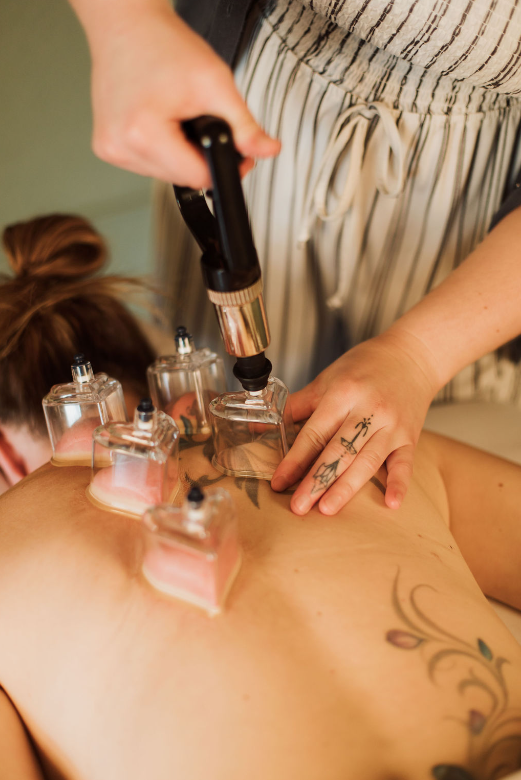
Cupping therapy is a very ancient practice. Depictions of cupping can be found in Islamic medical texts, Traditional Chinese Medicine, and the Ebers Papyrus. I love sharing about where these practices began, and who brought them to us, and do my best to honor the people whose medicine I practice.
So let's visit ancient Egypt, one of the first documented places to implement medical cupping. In addition to cupping found in the Ebers Papyrus, depictions of cupping therapy are found etched into temple walls in Kom Ombo. This temple dates back to the Ptolemaic dynasty, which existed from 180 - 47 BC.
Cupping was also widely practiced in China, where cupping placements were developed based on acupuncture points. Xi Hung, a Chinese herbalist and chemist (281 - 341), wrote “A Handbook of Prescriptions for Emergencies,” where he discusses cupping therapy techniques. In Traditional Chinese Medicine, fire cupping is practiced: a flame is briefly placed inside a glass cup to get rid of all the oxygen in the cup, which then creates a vacuum or suction, and the cup is quickly placed on the skin.
In the ancient world, cupping was used for medical, Shamanic, spiritual, and religious ceremonies. The cups themselves were commonly made of ceramic, hollowed out animal horns, glass, and bamboo.
Some cupping practices, like wet cupping, or blood-letting cupping, aren’t as common as they used to be. I’m not as knowledgeable about wet cupping; nevertheless, I do know the use and benefits of dry cupping have persisted for thousands and thousands of years. If you’d like to learn more about the history of cupping, check out this article!
Benefits of dry cupping include localized pain relief, increased circulation, reduced myofascial tension, and increased range of motion. I’ve witnessed the benefits of cupping in clients countless times throughout my six years as a cupping certified practitioner. My clients have reported immediate decreased pain, longer-lasting relief, better mobility, and less pain in general with regular cupping management sessions. I use cupping in my practice to help manage a variety of conditions, like hEDS, POTS, fibromyalgia, arthritis, carpal tunnel, tennis elbow, frozen shoulder, plantar fasciitis, neuralgia, anxiety, chronic trigger points… and the list goes on! Nowadays, cupping is commonly done with glass, plastic, or silicon cups.
Throughout my six years receiving cupping therapy from other practitioners, myself, and my partner when I can’t reach a spot and things are dire, I’ve found incredible chronic pain relief. Cupping has become a vital part of my bimonthly 90 minutes with my bodyworkers, Elysia and Mia, who help manage my pain from cervical arthritis, chronic headaches, vestibular migraines, TMJD, an old shoulder dislocation, a recurring wrist sprain, and patellofemoral syndrome. Thanks ladies!
Within the last decade, healthcare professionals and researchers have (finally) been studying more holistic medicines like cupping under the lens of “Western medicine” - and they'remaking some pretty cool discoveries.
The application of negative pressure (aka, a cup) was placed on the upper shoulder area of a research volunteer and studied through an MRI machine. Distinct changes to both the superficial and deep muscles occurred under decompression, including skin, fascia, and muscle. This change lasted even after the cup was removed. The researchers also cupped the hamstrings and noted that the area responded particularly well to negative pressure. This visual proof of the impact cupping has on our body is a wonderful step forward in incorporating new modalities into our healthcare system.
Of course, integration like this is a slow process, especially in our healthcare system, but I choose to celebrate the baby steps while continuing to push for more change! For example, this year, Certified Massage Therapists in CA are officially considered health-care practitioners! Exciting? Yes! But, what does this actually mean? Well, at the moment it’s mostly just a title. But in the long-term, I hope it will open up the door for research, medical treatments, and widespread access to pain relief and treatments. With every client helped and new research funded, we get closer and closer to this goal. Little, tiny, baby steps!
The last thing I will say is: as with most things, one person’s life-changing treatment may not be another person’s life-changing treatment. Maybe cupping feels too intense or “spicy,” or maybe it just doesn’t feel like much of anything for your body. Maybe some days you enjoy it, but other days not so much. That is all perfectly okay.
The wonderful thing about each body being entirely unique is that there are so many wonderful treatment options out there for pain management!
